
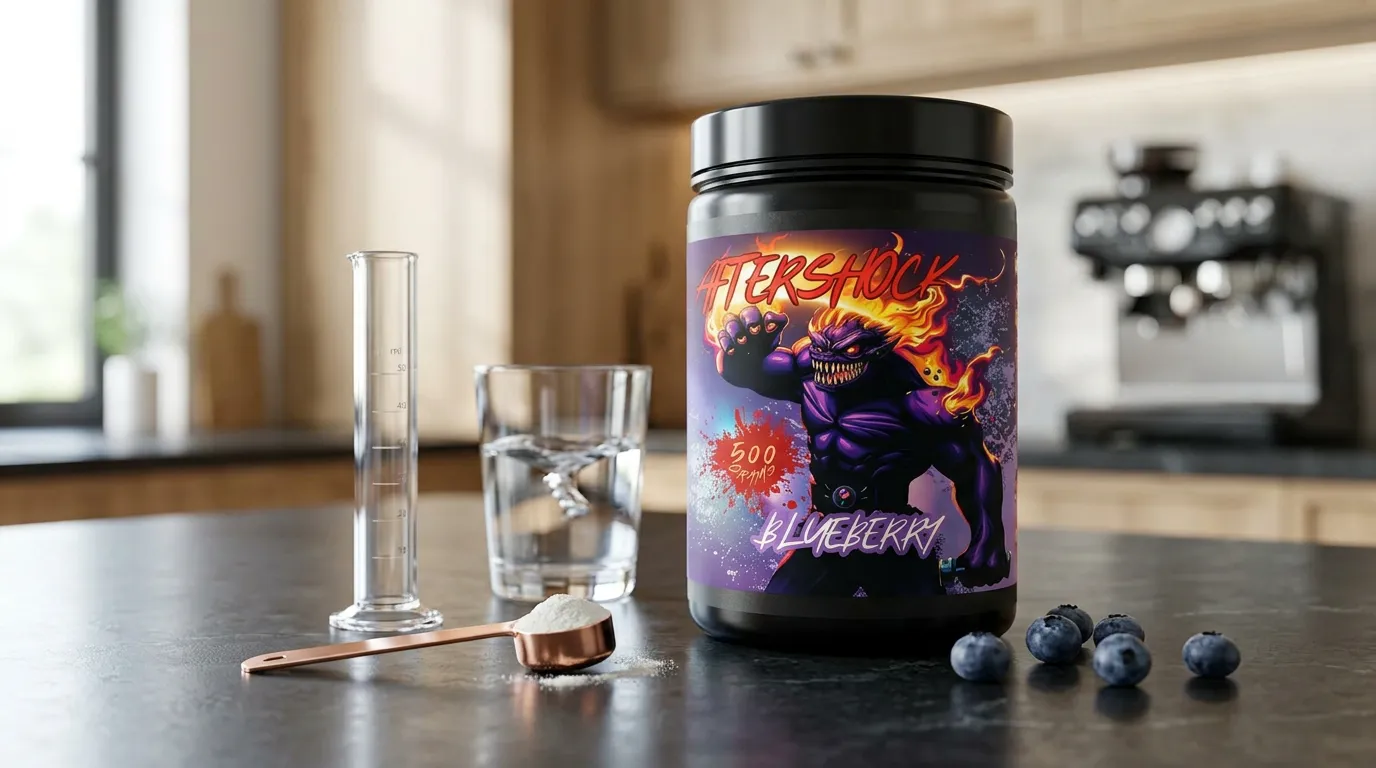
Creatine dosage is simpler than half the internet claims. For most people, 3 to 5 g of creatine monohydrate per day works. If you want to saturate muscle stores faster, you can use a loading phase of 20 to 25 g per day for 5 to 7 days, then switch to a maintenance dose. The key is not "magical timing," but consistency.
Creatine is among the best-researched sports supplements. The 2017 ISSN position stand states that it is the most effective ergogenic supplement for high-intensity performance and lean muscle mass growth. From a practical perspective, this means one thing: if you are dealing with creatine dosage, the correct daily dose and discipline are more important than complicated protocols.
„Creatine monohydrate is the most effective ergogenic nutritional supplement currently available to athletes.“
Creatine makes the most sense for strength, hypertrophy, sprints, and repeated high-intensity performance.
Quick answer: what is the correct creatine dosage?
| Situation | Recommended dose | For whom | Note |
|---|---|---|---|
| Regular daily use | 3 to 5 g per day | Most gym-goers and recreational athletes | Simplest and most sustainable regimen |
| Dosage by weight | 0.03 g/kg per day | If you want a more precise calculation | 80 kg person approx. 2.4 g, 100 kg approx. 3 g |
| Loading phase | 20 to 25 g per day for 5 to 7 days | When you want to saturate stores faster | Divide into 4 to 5 smaller doses |
| Loading by weight | 0.3 g/kg per day for 5 to 7 days | Heavier athletes or a short preparation block | Then switch to 3 to 5 g per day |
If you want to play it safe, stick to monohydrate. You can find a detailed comparison in the article Creatine Monohydrate vs. Other Forms: Differences.
Why creatine dosage is important
Creatine works through the phosphocreatine system and helps restore ATP faster, which is the immediate energy source for short and intense efforts. That is why it is mainly used in strength training, sprints, cross-training, and team sports with frequent changes in pace. It is not a stimulant like caffeine. You won't feel it after 20 minutes, but after days and weeks of regular use.
According to an older, still frequently cited review, more than 95% of total creatine is stored in skeletal muscle. This is also practically important: the result depends on whether you saturate these stores and then maintain them. If you take creatine only occasionally or only before training, you are making one of the most common mistakes.
You can also find broader context for sports supplements, recovery, and performance in the article Is Evolved Suitable for Athletes: Facts.
The best time for creatine is the one you can stick to every day without skipping.
Creatine dosage by goal
Strength, hypertrophy, and cross-training
If you want more strength, better training volume, and support for muscle growth, the standard is 3 to 5 g per day. For larger athletes or high training volumes, the upper limit is more practical. Creatine does not act as a "pump" here, but rather as the ability to perform a higher-quality set, recover better between intervals, and maintain performance in the long term.
Weight loss and recomposition
Do not automatically discard creatine during a diet. It can help maintain strength and muscle mass, which is often more valuable during reduction than a short-term drop in the number on the scale. Yes, some people experience a slight weight increase due to intracellular water in the muscles, but that is not the same as fat.
Endurance sports
For pure endurance, creatine is not the first supplement you reach for. It makes sense especially when the training includes strength, intervals, finishes, or the need to maintain performance during repeated intense segments. Keep your expectations realistic: the effect tends to be less consistent than in strength and sprinting.
Seniors, women, vegetarians
People with lower meat intake may have lower baseline creatine stores, and therefore the effect may be more noticeable. A 2025 review for older adults states that creatine combined with training can support muscle mass, strength, and functionality. For everyday life, however, a reasonable baseline remains 3 to 5 g per day.
-
Beginner: 3 g per day.
-
Regular recreational athlete: 3 to 5 g per day.
-
Heavier or strength-oriented athlete: closer to 5 g per day.
-
If you want a precise calculation: approx. 0.03 g/kg per day.
-
If you are in a hurry for fast saturation: 0.3 g/kg per day for 5 to 7 days.
If you are also building a broader stack for focus, performance, and recovery, check out Nootropics for Focus: What Works, Nootropics for Focus: Effects, Doses, and Risks, and Nootropics and Functional Mushrooms: Effects and Selection.
Is a loading phase necessary?
No. A loading phase is functional but not mandatory. If it is enough for you to reach full stores gradually, take 3 to 5 g per day and don't make a project out of it. However, if a competition, performance testing, or a demanding training block is approaching, loading can be practical.
-
If you want simplicity and minimum risk of digestive issues, choose 3 to 5 g per day.
-
If you want a faster onset of saturation, choose 20 to 25 g per day for 5 to 7 days.
-
Always divide loading into several smaller doses throughout the day.
-
After loading, switch to 3 to 5 g per day.
It is also important that creatine does not need to be cycled. The 2017 ISSN position stand mentions safe use of up to 30 g per day for 5 years in healthy individuals in studied protocols. Furthermore, a newer 2025 review argues that creatine is safe and beneficial across the lifespan.
If you also get creatine from a pre-workout, count your total daily intake. Both Aftershock Original (V1) and Aftershock V2 Premium (V2) contain 2.5 g of creatine per dose, so with a goal of 5 g per day, you often need to supplement the rest separately. For product details, you can also check out Aftershock Original.
Creatine works best in a routine where you have mastered training, sleep, hydration, and recovery.
When to take creatine and what to combine it with
Timing is secondary. On training days, you can take it before training, after training, or with a meal. On non-training days, anytime. The best time is the one you can repeat daily without skipping.

If you have sensitive digestion, take creatine with food and drink plenty of water. It makes sense to combine it with regular sports nutrition, not with complicated rituals. When working with stimulants, monitor your caffeine intake as well. If you use pre-workouts, compare the differences between Aftershock Original (V1) and Aftershock V2 Premium (V2).
For recovery, it is also worth addressing magnesium and sleep. A related article is Magnesium for Recovery: When and How Much to Take, and for an evening routine, the product Chilliček may also be relevant.
If you are also focusing on performance and focus, connect the topic with the articles Lion's Mane vs. Alpha GPC: Which is Better for Focus and Lion's Mane vs. Alpha GPC: What to Choose.
Most common mistakes when taking creatine
-
You only take it before training. Creatine makes sense daily, even on non-training days.
-
You take the loading dose all at once. The result is usually bloating or diarrhea, not a better effect.
-
You expect a "kick" after two weeks. Creatine is not a stimulant.
-
You fall for the marketing of exotic forms. Monohydrate is still the gold standard.
-
You don't count the total daily intake from multiple products. This is a frequent reason why you actually take less than you think.
-
You ignore your health status. In case of kidney disease, nephrotoxic drugs, pregnancy, or a complicated internal condition, consult a doctor.
In a 2025 meta-analysis evaluating 21 studies, a small increase in creatinine was confirmed, but without evidence of worsening glomerular filtration in standard protocols. This is why it makes sense to tell your doctor that you are taking creatine, especially if you are going for blood tests.
Who should exercise increased caution
If you are a healthy adult, creatine is among the safer supplements. However, caution is advised in cases of known kidney disease, when taking medications with a potential impact on the kidneys, during pregnancy, breastfeeding, and with complicated diagnoses. General recommendations for supplement and drug interactions can also be found on NCCIH.

If you want to approach supplements systematically, other related articles are also useful: Nootropics for Focus: Effects, Doses, and Risks and Nootropics and Functional Mushrooms: Effects and Selection.
Recommended sources and links
-
PubMed: Creatine monohydrate supplementation for older adults and clinical populations (2025)
-
PubMed: Systematic review and meta-analysis on kidney function (2025)
-
PubMed: Creatine is safe and beneficial throughout the lifespan (2025)
FAQ
How many grams of creatine per day is suitable for a beginner?
For a beginner, the most practical start is 3 g per day. If they have a higher body weight or training volume, they can go up to 5 g per day.
Should creatine be taken even on non-training days?
Yes. Creatine works by maintaining saturated muscle stores, so daily consistency is more important than the time of intake itself.
Does a loading phase make sense for creatine?
Yes, but it is not mandatory. It is suitable when you want to saturate muscles with creatine faster. If you are not in a hurry, 3 to 5 g per day without loading is sufficient.
Is it better to dose creatine by weight or a fixed amount?
For most people, a fixed 3 to 5 g per day is enough. Dosage by weight around 0.03 g/kg per day makes more sense when you want a more precise approach for very low or high body weights.
Is creatine suitable during weight loss?
Yes. During a diet, it can help maintain strength and muscle mass. A slight weight increase after starting is often just a result of higher water retention in the muscles.
Try Aftershock and experience the power of nootropics.
Order Aftershock