
Nootropics and functional mushrooms are often lumped together, but when making a real choice, it makes sense to distinguish between an acute "focus" effect and longer-term support. If you want better concentration, more stable energy, or a smarter approach to stress, the composition, dose, timing, and extract quality matter most. Not the marketing name.
This guide cuts the topic down to the essentials: what the difference is between these categories, which substances are most studied, how to read the label, and who they are suitable for. If you are addressing performance in a broader context, follow up with the article How to Increase Focus: 10 Steps for Higher Performance.
Caffeine is among the most researched nootropic substances for alertness and attention.
What are nootropics and functional mushrooms and how they differ
Nootropics are a broader category of substances associated with focus, alertness, mental performance, or fatigue resistance. These can include stimulants, amino acids, and certain plant and mushroom extracts. Functional mushrooms are a narrower group. These are mushrooms used for their bioactive content, such as beta-glucans, hericenones, or triterpenes.
In practice, the difference is simple. Nootropics are more often used for a faster or more noticeable effect on focus and alertness. Functional mushrooms are more commonly included in a routine for a gentler, longer-term profile. However, this does not mean they do not overlap. Lion's Mane is a good example of a substance that people perceive as both a functional mushroom and a nootropic ingredient.
| Category | Main Goal | Typical Onset | Examples |
|---|---|---|---|
| Nootropics | Focus, alertness, reaction time | Often fast | Caffeine, L-theanine, tyrosine |
| Functional mushrooms | Stress, balance, long-term support | Often gradual | Lion's Mane, reishi, cordyceps |
| Combined formulas | Focus and performance | Depends on the formula | Pre-workouts and focus blends |
Therefore, when choosing, do not start with the question "what is trendier," but rather what do I want to use it for. A different composition is suitable for a work block, another before training, and another in the evening. For the sports part of the topic, Supplements for Athletes: What to Know Before Choosing is also relevant.
Nootropics and functional mushrooms for focus, energy, and stress
When addressing focus, most people look for a combination of three effects: higher attention, less mental noise, and more stable energy without a sharp crash. Here, caffeine is usually the most practical, potentially combined with L-theanine. This pair is among the most frequently discussed nootropic strategies.
Expectations for functional mushrooms are different. Lion's Mane is mainly associated with the cognitive area, reishi more with a calmer profile, and cordyceps with vitality. However, this does not mean every mushroom works as an immediate "kickstarter." For several products, it is more realistic to expect regular use over days to weeks.
In 2015, EFSA stated that "Habitual caffeine consumption up to 400 mg per day" does not raise safety concerns for healthy non-pregnant adults.
This figure is important mainly because people often do not count their total stimulant intake. One coffee, an energy drink, and a pre-workout can total significantly more than you planned. According to EFSA, a safe single intake for most healthy adults is considered to be approximately 200 mg of caffeine, with a common daily limit of 400 mg.
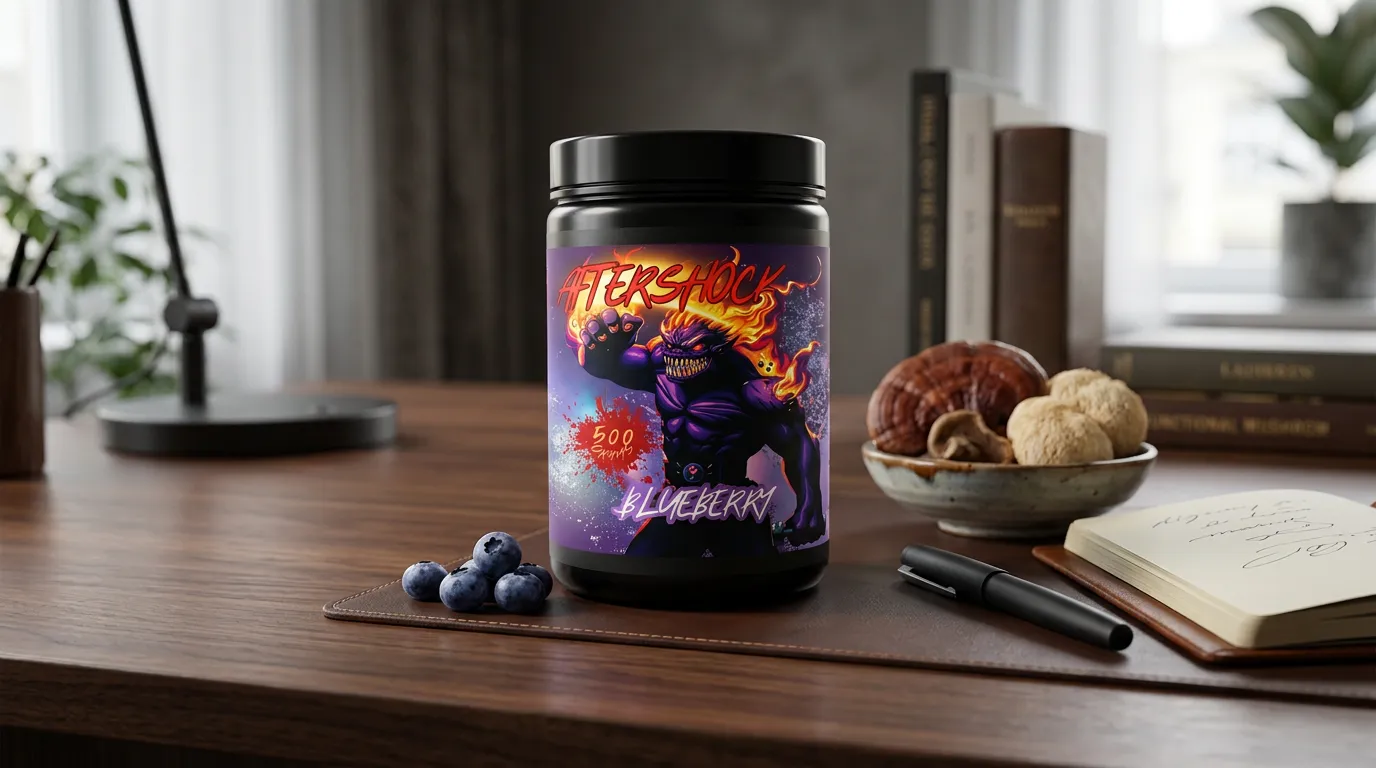
If you want focus before training or gaming, a transparent formula is more practical than a "brain blend" without dosages. This is where products like Aftershock Original (V1) or Aftershock V2 Premium (V2) have their place, where the dose of caffeine and L-theanine is clearly visible. In the evening, on the other hand, it is worth avoiding stimulants. We cover magnesium forms in Magnesium for Sleep: Which Form Works Best, and Chilliček is a caffeine-free magnesium option, though not a sleep product.
Lion's Mane is among the most frequently mentioned functional mushrooms in the context of focus.
Which substances and mushrooms are among the most researched
Caffeine remains the most researched substance for alertness and attention. L-theanine is often discussed in combination with caffeine because it can help soften a subjectively "sharp" stimulation profile. L-tyrosine is interestingly mentioned in the context of mental load and demanding days, but results should be read realistically.
In the world of functional mushrooms, Lion's Mane is the most discussed. In human data, we are not yet talking about a miracle substance, but about an interesting raw material with a limited but growing number of studies. For example, a 2023 pilot double-blind study followed 41 healthy adults who took 1.8 g of Lion's Mane for 28 days. The results suggested faster completion of the Stroop test after a single dose, but the authors also emphasized that it was a small sample and conclusions need to be confirmed in larger studies.
For caffeine and L-theanine, support is also found in a 2021 systematic review, which describes the potential of this combination for attention and cognitive performance. This is not a reason to believe every marketing claim, but it is a more sensible foundation than an anonymous blend without dosing.
Regarding safety and quality, it is also worth following general recommendations from the NCCIH and the NIH Office of Dietary Supplements. Both institutions repeatedly warn that a supplement may not be the same as the product tested in a study and that interactions with medications, individual status, and exact composition are important.
If you are specifically interested in Lion's Mane, continue to Lion's Mane Effects: What Studies Show in Practice.
How to choose a quality product based on composition and dosages
The biggest mistake regarding the topic of nootropics and functional mushrooms is blind trust in the product name. A quality supplement must show exact amounts per dose. If the label hides everything in a "proprietary blend," you cannot realistically evaluate either effectiveness or tolerance.
-
Look at the dose: with caffeine, it is not just the effect that matters, but also whether it will disrupt your sleep.
-
Watch the form: with mushrooms, there is a difference between the fruiting body, mycelium, and standardized extract.
-
Address the goal of use: work focus, training, gaming, and evening recovery are not the same thing.
-
Avoid unclear blends: without a breakdown, you don't know what you are buying.
-
Verify brand communication: a serious brand explains limits, not just benefits.
For performance-oriented products, it is practical when you can see the composition without guessing. If you are addressing focus during training, it is worth comparing Best Pre-workout 2026. If you are interested in the performance part of formulas, follow up with Beta Alanine Effects, Dosage, and Timing and Creatine Monohydrate: Complete Dosage Guide.
This simple filter can help with practical decision-making:
-
First, determine if you want acute focus or longer-term support.
-
Then, calculate all sources of caffeine throughout the day.
-
Next, check the exact amounts of active substances.
-
For mushrooms, look for information on the extract type and standardization.
-
Start lower and monitor the reaction, not the hype.
Reishi is more often included in a regimen for a calmer profile than for an acute stimulus.
Who nootropics and functional mushrooms are suitable for and what to watch out for
Nootropics and functional mushrooms can be interesting for students, people with mentally demanding jobs, athletes, and gamers. However, suitability is not universal. It depends on sensitivity to stimulants, health status, medications, sleep quality, and what you realistically expect from the supplement.
If you are a beginner, do not make the classic mistake of layering multiple products at once. Coffee, an energy drink, a pre-workout, and another "focus booster" can quickly turn into an unnecessarily high stimulation load. This is exactly the moment when a good intention turns into nervousness, poorer sleep, and a subsequent crash.
-
With caffeine, mainly monitor the timing of use and the total daily dose.
-
With functional mushrooms, do not automatically expect an immediate effect after the first dose.
-
With medications or diagnoses, consultation with a doctor or pharmacist is advisable.
-
During pregnancy and breastfeeding, caution is even more important.
-
For evening use, non-stimulant strategies make more sense.
That is why it is sensible to link the topic of focus with the basics of recovery. If you sleep poorly, a supplement will not solve the core of the problem. In this regard, it makes sense to combine information from the articles Magnesium for Sleep: Which Form Works Best and How to Increase Focus: 10 Steps for Higher Performance.
What else to read on the Evolved blog
If you want to get a broader picture of performance, concentration, and supplement selection, these articles naturally follow the topic of nootropics and functional mushrooms:
FAQ
What is the difference between nootropics and functional mushrooms?
Nootropics are a broader category of substances associated with focus, alertness, or mental performance. Functional mushrooms are a specific group of natural substances that can also have a nootropic profile, but are more often included in topics like stress, adaptation, and balance.
When do the effects of functional mushrooms on focus manifest?
It depends on the specific mushroom, dose, extract quality, and goal of use. Unlike caffeine, functional mushrooms are often expected to be used regularly over days to weeks rather than having an immediate effect after a single dose.
What to watch out for when choosing a nootropic supplement?
Monitor exact doses, clearly stated forms of substances, extract type, and whether the composition fits your goal and stimulant tolerance. Caution is warranted with unclear blends without a breakdown, when combining multiple stimulating products, and with concurrent medication use.
Are nootropics and functional mushrooms also suitable before training?
Yes, but it depends on the formula. Before training, a product with a transparent dose of caffeine and other performance substances makes more sense than an indefinite "focus blend." Practical context for this is provided by Aftershock Original (V1) and Aftershock V2 Premium (V2).
Can functional mushrooms replace sleep or a good routine?
No. Supplements can be support, not a replacement for sleep, quality diet, exercise, and sensible stress management. If the foundations are weak, the result will be limited regardless of what is on the label.
Try Aftershock and experience the power of nootropics.
Order Aftershock