
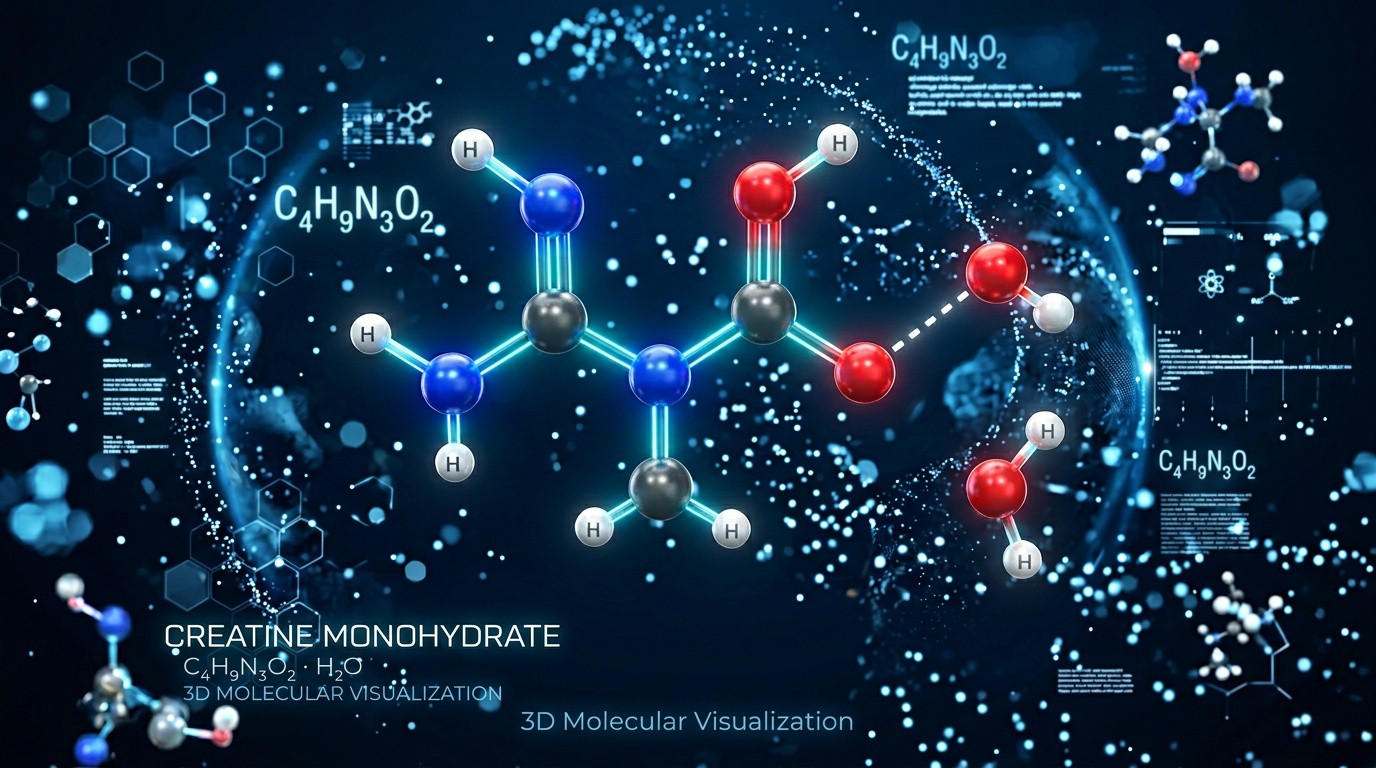
Creatine has spent the last few years being discussed well outside the weight room, in connection with memory, focus and the fog that follows a bad night of sleep. Part of that interest is justified and part of it is marketing. This article sets out what we actually know about creatine and the brain, who stands to gain the most, and where the research is still very young.
Short answer
The mechanism is plausible: the brain runs the same creatine system as muscle. The effects in healthy adults are small and inconsistent. The clearest signals appear in vegetarians, in older adults and under sleep deprivation. There is no authorised health claim for creatine and cognition, so this is not a focus pill.
Contents
- Short answer
- Why creatine is studied in the brain
- What the studies show
- What the research does not support
- When it makes the most sense
- Dosage and safety
- Fitting it into a routine
- Frequently Asked Questions
- Sources
- Related articles
Why creatine is studied in the brain
The brain accounts for about two percent of body weight and consumes roughly a fifth of the body's energy. Neurons run the same machinery as muscle cells: creatine and phosphocreatine act as a buffer that keeps ATP levels steady in the moments when demand outruns supply.
That is why the research concentrates on situations where the brain is under energetic pressure. Sleep deprivation, prolonged mental load, older age and a low dietary creatine intake are the states in which an effect is worth looking for. In a well rested, well fed twenty year old the stores are already close to full, so there is nothing to top up and little to improve.
One important difference from muscle: creatine crosses the blood brain barrier slowly and in smaller amounts. Muscle saturates within days to weeks, whereas measured changes in brain creatine tend to be smaller, slower and far from uniform between people.
The body also makes part of its own creatine from amino acids in the liver, kidneys and pancreas, and we take in the rest from meat and fish. The brain has some synthesis capacity of its own, which is one reason its pool is more stable than the muscle pool and shifts less with supplementation. That is exactly why effects show up mainly where the starting point is low.
What the studies show
The best starting point is the 2018 meta-analysis by Avgerinos and colleagues, which pooled randomised trials in healthy people. The conclusion: creatine produced a modest improvement in short term memory and in some reasoning tasks. Results for long term memory, spatial memory, attention and processing speed were inconsistent. The authors also warned that the trials were small and methodologically varied, so confidence in the conclusion is low.
The second repeated finding concerns who responds. Vegetarians and vegans start from lower baseline stores, and they are where effects surface most often. The same pattern holds for older adults. In young meat eaters the results are the weakest of all.
The most quoted recent paper is Gordji-Nejad and colleagues, 2024, in which a single high dose of creatine during a night without sleep improved processing speed and short term memory. That study had fifteen participants, one night and a dose several times higher than a normal daily serving. A sample that size does not support a recommendation, and the authors say so themselves. It is an interesting signal, not an instruction.
In summary: with the brain we are talking about small effects in specific situations, not a reliable upgrade to how well you think.
What the research does not support
In the European Union there is no authorised health claim linking creatine to cognitive function. The only authorised claim concerns physical performance in successive bursts of short, high intensity exercise. That is not a formality: it means regulators do not yet consider the cognitive effect sufficiently documented.
Creatine is also not a stimulant. It has no acute effect that you would feel after a dose the way you feel caffeine. It works through gradual saturation of tissue, so expecting a kick from the first drink is the wrong frame entirely.
Finally, creatine does not replace sleep, does not treat anxiety or depression, and is not a therapy for any diagnosis. Trials in psychiatric populations do exist, but that is clinical research, not a reason for anyone to self prescribe creatine instead of treatment.
When it makes the most sense
Vegetarians and vegans are the clearest group. A meat free diet supplies almost no creatine, so baseline stores are lower and there is more room to move.
People in sleep debt are the second group, although the data here are still thin. If you are sleeping five hours because of a small child or night shifts, creatine will not fix the cause, but it is a cheap and safe thing to try alongside actually addressing the sleep.
Older adults have lower stores and respond better than younger people in trials. A fourth group are people under sustained mental load, such as an exam period or a punishing stretch at work. This is where the answer is least certain and expectations should stay low.
A useful rule for deciding: the closer your baseline is to full stores, the less room there is for change. If you eat meat five times a week, sleep seven hours and train, creatine will probably help you in the gym and change very little in your head. If the opposite is true, it is worth a month of your attention.
Dosage and safety
The dose is the same as for training: 3 to 5 g of creatine monohydrate per day, every day, including days without training. There is no reason to buy a special "brain" form, because the studies used ordinary monohydrate. The full picture, including a table by body weight, is in the article on creatine dosage, and the raw material itself is covered on the creatine monohydrate page.
Expect brain stores to fill more slowly than muscle stores, so if you are testing this on yourself, give it at least four to six weeks. Creatine is among the best studied supplements available and its safety profile in healthy adults is good.
If you are pregnant or breastfeeding, have kidney disease, take medication, or you are asking on behalf of a child or teenager, talk to a doctor first. The same applies if you are dealing with memory problems that worry you. A food supplement is not a diagnosis.
Fitting it into a routine
In practice this is boring, which is a good sign. One dose a day, at a time you will remember, ideally with a meal. Do not agonise over morning versus evening, because when the mechanism is tissue saturation, timing does not decide anything.
Cycling has no research behind it. Stores fall slowly after you stop, so a break resets nothing and simply returns you to the starting line. If you want to know whether this does anything for you, track something measurable, such as mistakes at work on poorly slept days, rather than how you feel on day one.
Frequently Asked Questions
Does creatine help with focus while studying or working?
The average effect in healthy adults is small and inconsistent. The 2018 meta-analysis found a modest improvement in short term memory and some reasoning tasks, while results for attention did not line up. If you sleep enough and eat meat, do not expect much. Vegetarians, older adults and periods of sleep debt have more room to gain.
What dose is used in brain studies?
Most trials used ordinary monohydrate at roughly 5 g per day, some with a short loading phase. Single very high doses have appeared too, but those were experimental and are not a recommendation for regular use. The practical choice remains 3 to 5 g per day, taken consistently over months rather than days.
Is creatine worth taking if I do not train?
It can be. Creatine is not tied to training and it fills tissue stores whether or not you lift. Without training, though, you give up the part that is best documented, which is the effect on physical performance. What remains is a possible benefit for energy hungry tissue, and that evidence is considerably weaker.
Is creatine a nootropic?
Not in the way the word is used in advertising. Creatine is not a stimulant and has no acute effect on attention. It works through gradual tissue saturation, and its effects on thinking are small at best and tied to specific groups of people. There is also no authorised health claim for creatine and cognitive function.
Who should be careful with creatine?
People with kidney disease, pregnant and breastfeeding women, people on medication, and adolescents. In all of those cases the question belongs to a doctor rather than to an article. In healthy adults creatine raises serum creatinine as a laboratory value, which is worth mentioning before a blood test so the result is not misread.
Sources
- Avgerinos K. I. et al., 2018. Effects of creatine supplementation on cognitive function of healthy individuals: a systematic review of randomized controlled trials. Experimental Gerontology 108.
- Gordji-Nejad A. et al., 2024. Single dose creatine improves cognitive performance and induces changes in cerebral high energy phosphates during sleep deprivation. Scientific Reports 14.
- Kreider R. B. et al., 2017. ISSN position stand: safety and efficacy of creatine supplementation in exercise, sport, and medicine. Journal of the International Society of Sports Nutrition 14:18.
- EFSA Journal 2011;9(7):2303. The authorised claim concerns physical performance, not cognitive function.
- NIH Office of Dietary Supplements. Dietary Supplements for Exercise and Athletic Performance.
Related articles
Chillicek gives you 375 mg of elemental magnesium per serving, as bisglycinate.
See Chillicek