
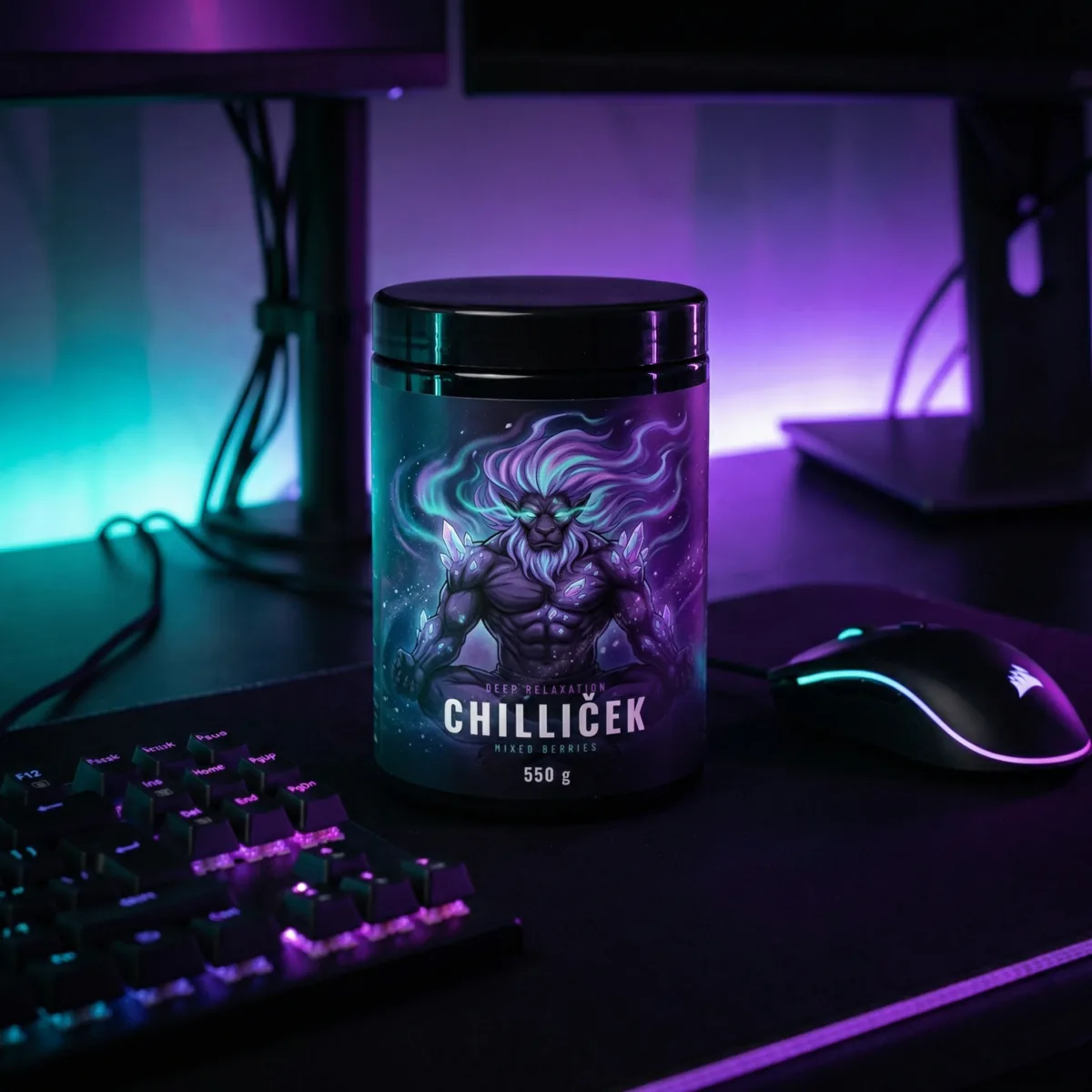
What makes Chillíček different from tablets is the format, not only the form of magnesium. Bisglycinate powder lets one scoop carry the full 375 mg of elemental magnesium, which would take several tablets. The 550 g tub holds 91 servings.
Short answer
Bisglycinate is magnesium bound to two glycine molecules. It carries less elemental magnesium per gram than oxide, but it is far gentler on digestion. A full reference dose of 375 mg of elemental magnesium means roughly three grams of raw material, which is more than fits in one tablet. That is why chelated forms are so often sold as powder.
Contents
- Bisglycinate, citrate, oxide, malate: what sets them apart?
- Powder versus tablets and capsules
- What is in one serving?
- Who is it for and who is it not?
- Frequently Asked Questions
- Sources
Bisglycinate, citrate, oxide, malate: what sets them apart?
Magnesium never appears on its own in a supplement. It is always attached to a carrier, and the type of bond decides how the compound behaves in the digestive tract. The split is simpler than it looks: either it is an inorganic salt, or it is a chelate with an organic acid or an amino acid.
Inorganic salts, meaning the oxide, carbonate, chloride and sulphate, carry a high share of elemental magnesium per gram. Oxide sits around 60 percent, which looks excellent on paper. The problem is that it dissolves poorly in the gut and studies put its absorption in the low single digit percentages. What is not absorbed draws water in and works osmotically, which is exactly why oxide has a reputation as a cheap laxative.
Citrate is an organic salt and sits in the middle. Its elemental share is around 16 percent, it dissolves well, and it outperforms oxide in comparative work. At higher doses it still acts as a mild laxative, which is unwelcome in an evening routine. Malate is a similar case at around 15 percent. The advice to take it during the day because of the malic acid comes from marketing rather than from evidence, and direct data favouring daytime over evening use are missing.
Bisglycinate is a chelate: one magnesium atom bound to two molecules of glycine, the simplest amino acid. That bond changes how the molecule behaves in the gut, which is why tolerance is markedly better than with inorganic salts. The price is a lower elemental share, roughly 12 to 14 percent depending on the raw material, because much of the mass is the glycine itself. What the studies on glycine itself did and did not show is covered in the article on glycine and recovery. A table covering all six forms sits in the article on magnesium and sleep; the four you meet most often are enough here.
| Form | Elemental Mg share | Tolerance | Typical use |
|---|---|---|---|
| Bisglycinate | 12 to 14 percent | good | evening, long term |
| Citrate | around 16 percent | can loosen stools at higher doses | common budget supplements |
| Oxide | around 60 percent | poor absorption, loosens stools | cheap multivitamins |
| Malate | around 15 percent | good | positioned for daytime by marketing, no direct data |
The word bisglycinate also hides two different things. Some raw materials on the market are buffered, meaning blended with oxide to lift the elemental share per gram. You can spot it when the declared share is noticeably higher than a pure chelate allows. That is not fraud, but it is not the same product either, and the label should say so.
Powder versus tablets and capsules
This is the heart of it, and it is ordinary arithmetic. The nutrient reference value for magnesium is 375 mg of elemental magnesium. In a chelated raw material that means roughly three grams of powder. A tablet usually holds seven hundred to a thousand milligrams of active raw material, which at an elemental share of 12 to 14 percent works out at eighty to one hundred and forty milligrams of elemental magnesium.
The conclusion is blunt: reaching the full daily value from pure bisglycinate takes three to five tablets or capsules a day. That is not merely inconvenient. It is the main reason people give supplementation up after a fortnight, and a supplement you do not take cannot do anything.
| Format | Elemental Mg per unit | Units needed for 375 mg | Splitting the dose |
|---|---|---|---|
| Tablet of pure chelate | 80 to 140 mg | three to five | in half |
| Capsule of pure chelate | 80 to 140 mg | three to five | not really possible |
| A 6 g scoop of powder | 375 mg | one | any fraction |
The values are typical rather than universal. If a manufacturer does not state the elemental magnesium per tablet and advertises only the weight of the compound, you have to do the conversion yourself, and you will usually find the number on the front of the pack is the raw material weight.
The second difference is dosing precision. A scoop of powder can be halved while you work out what suits you. A tablet splits in two at best, and a capsule does not split at all.
Powder has real drawbacks and there is no point hiding them. You need a glass of water at hand, a scoop is less precise than a pressed tablet, and the flavour has to be solved somehow. Anyone who needs to carry a supplement in a backpack has an easier time with capsules.
What is in one serving?
Here is a concrete example of how such a label reads. One 6 g scoop of Chilliček contains 3125 mg of magnesium bisglycinate, of which 375 mg is elemental magnesium, meaning 100 percent of the nutrient reference value. The rest of the scoop is the flavoured base.
The second ingredient is vitamin B6 at 1.4 mg, in the form of pyridoxal-5-phosphate, written as P-5-P. That is the active coenzyme form, which the body does not have to convert first, unlike ordinary pyridoxine hydrochloride.
What may be said about these two ingredients is tightly defined. Magnesium contributes to the reduction of tiredness and fatigue, to normal muscle function, to normal functioning of the nervous system and to normal psychological function. Vitamin B6 contributes to the reduction of tiredness and fatigue and to normal psychological function. Do not read anything more into it. This is not a sleep medicine or a product for relaxation or cramps, and sleep is not an authorised claim for magnesium. Wider background on the mineral sits on the magnesium ingredient page.
The pack holds 550 g, which at one scoop a day works out at 91 servings. That number is more useful than the pack weight when comparing products, because it tells you how long a pack actually lasts.
Who is it for and who is it not?
A chelated powder makes sense for three people. For anyone who dislikes swallowing tablets and therefore does not take them consistently. For anyone whose digestion objects to cheaper salts. And for anyone who wants the full reference dose in one go rather than assembled from three capsules.
It makes no sense for someone who needs to carry a supplement around and take it away from home, or for someone whose current form works perfectly well. Switching forms because one is more expensive is not a reason.
One group should be particularly careful: people with kidney disease, pregnant and breastfeeding women, and anyone taking medicines magnesium can interact with, such as certain antibiotics or thyroid medication. In those cases speak to a doctor or pharmacist, ideally before the first serving.
Frequently Asked Questions
Is bisglycinate the same thing as glycinate?
In practice the two names are used interchangeably and most manufacturers apply them to the same raw material. Bisglycinate is the more precise term, because it says that two glycine molecules sit on each magnesium atom. If two labels use different names, look at the elemental magnesium content rather than at the trade name of the form.
Why does bisglycinate carry less magnesium per gram?
Because much of the mass is the carrier, the glycine itself. Oxide is around 60 percent elemental magnesium, bisglycinate roughly 12 to 14 percent depending on the raw material. That number says nothing about how much is actually absorbed, though. Oxide absorbs poorly, so its higher share per gram does not translate into a higher intake.
How many tablets does one scoop replace?
It depends on the product, but a pure chelate tablet typically carries eighty to one hundred and forty milligrams of elemental magnesium. The full reference value of 375 mg therefore usually works out at three to five tablets a day. That number is exactly why so many people abandon consistent supplementation.
Why is the vitamin B6 in the P-5-P form?
Pyridoxal-5-phosphate is the active coenzyme form of vitamin B6, which the body does not have to convert in the liver first. Vitamin B6 contributes to the reduction of tiredness and fatigue and to normal psychological function, so it pairs logically with magnesium. The 1.4 mg amount covers the reference value, so it is not a megadose.
Can bisglycinate still upset digestion?
It can, though far less often than inorganic salts. When it happens, the usual cause is starting too high. The fix is to begin with half a scoop, take it with food, and increase only after a few days. If the trouble persists even at a low dose, take it to a doctor.
When is the best time to take the powder?
Any time of day, for example in the morning or in the evening after dinner, whenever it fits your routine. The exact hour is not critical, because this is long term replenishment rather than an acute effect. Consistency matters more. If your stomach is sensitive, take it with food.
Sources
The elemental shares follow from the molecular weights of the individual salts, and the absorption ratings from the reviews below. Direct head to head trials between forms are scarce and mostly small, so differences between chelates and organic salts should be treated as indicative rather than settled.
- NIH Office of Dietary Supplements: Magnesium. Fact Sheet for Health Professionals.
- EFSA NDA Panel: Scientific Opinion on the substantiation of health claims related to magnesium. EFSA Journal 2009;7(9):1216 and EFSA Journal 2010;8(10):1807.
- Commission Regulation (EU) No 432/2012, list of permitted health claims (EU Register).
- EFSA SCF: Opinion of the Scientific Committee on Food on the Tolerable Upper Intake Level of Magnesium (2001).
- Walker A. F. et al.: Mg citrate found more bioavailable than other Mg preparations. Magnesium Research, 2003. Small comparative study, 46 participants.
- Schuchardt J. P., Hahn A.: Intestinal absorption and factors influencing bioavailability of magnesium. Current Nutrition and Food Science, 2017. Review.
Related articles
Chillicek gives you 375 mg of elemental magnesium per serving, as bisglycinate.
See Chillicek