

Mental focus is rarely a pure motivation problem. More often it breaks down because of poor sleep, too much noise, badly timed caffeine, and constant context switching. This guide focuses on practical fixes that make sense for work, study, and training.
Table of Contents
- Key Takeaways
- What affects focus the most
- Step 1: Fix sleep and daily rhythm first
- Step 2: Use caffeine and supplements sensibly
- Step 3: Build an environment that supports focus
- Step 4: Train attention like a skill
- Most common mistakes
- Where Aftershock may make sense
- Frequently Asked Questions
- Related Articles
Key Takeaways
| Takeaway | Detail |
|---|---|
| Sleep matters more than most supplements | If sleep is poor, caffeine often masks the problem instead of solving it. |
| Caffeine can help, but dose matters | Higher doses often mean more jitteriness, poorer sleep, and worse self-control. |
| Better environment beats another “hack” | Fewer notifications and less task switching often improve focus faster than another stimulant. |
| Attention improves with practice | Mindfulness, deep-work blocks, and single-tasking are more useful than constant multitasking. |
What affects focus the most
Focus depends on several layers at the same time. You need alertness, manageable stress, low distraction, and enough mental energy to stay with one task. When one of those layers falls apart, concentration follows.
In practice, the biggest offenders are:
- poor or inconsistent sleep
- too much caffeine at the wrong time
- nonstop task switching
- chat apps and notification overload
- stress that never gets processed
Research consistently supports the role of sleep, exercise, and sensible caffeine use in alertness and performance. ISSN position stand on caffeine and performance
Before asking what to take, ask what is currently taking your focus away.
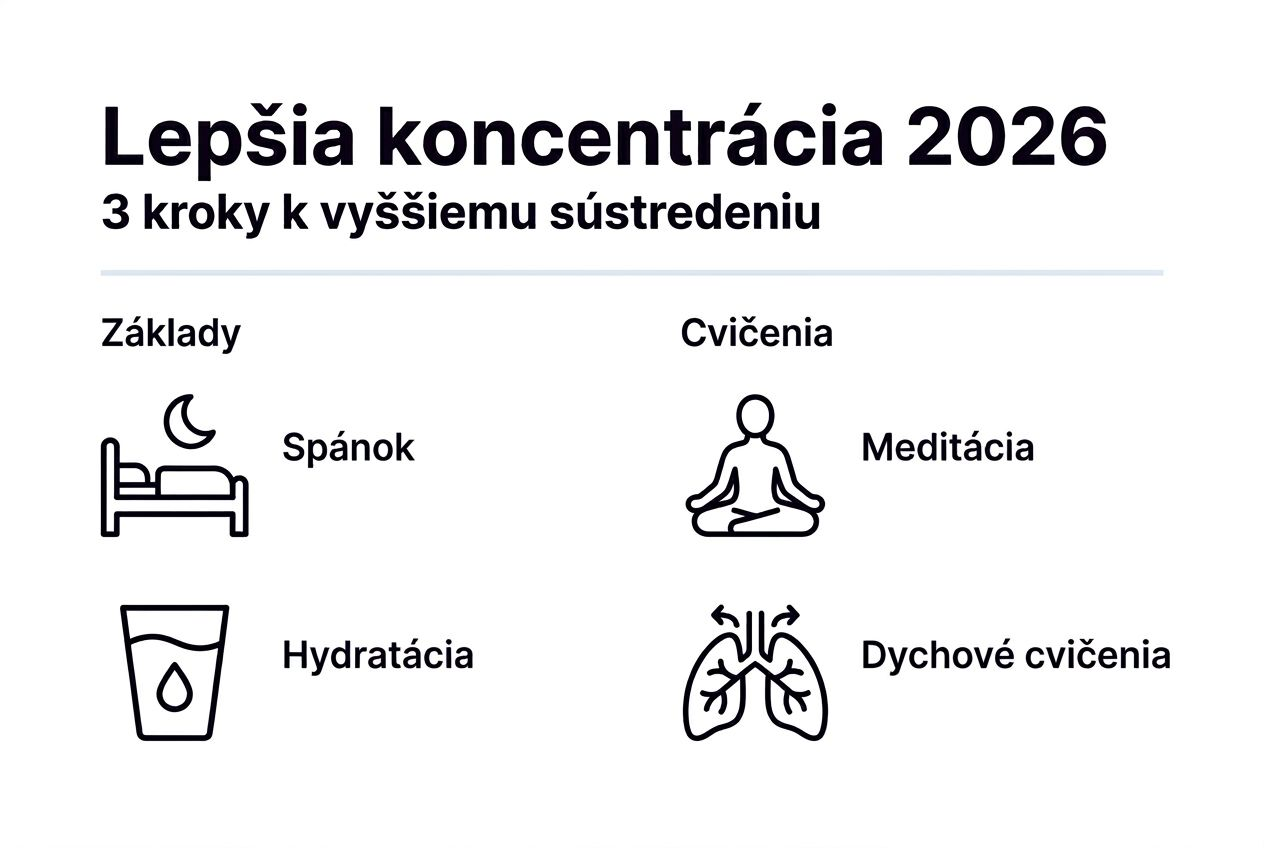
Step 1: Fix sleep and daily rhythm first
Sleep is the biggest multiplier and the biggest saboteur. When sleep quality drops, alertness, working memory, and self-control usually drop with it.

Start with three basics:
- Wake up at roughly the same time every day.
- Keep your last meaningful dose of caffeine to early afternoon.
- Reduce light and mental stimulation during the last hour before bed.
You do not need perfect biohacking. You need predictability. If every morning starts differently and every evening ends with another hit of caffeine or scrolling, focus becomes harder to maintain.
| Area | Practical minimum |
|---|---|
| Sleep | Consistent wake time and 7+ hours in bed |
| Morning | Light, movement, water, no repeated snooze cycle |
| Evening | Less light, fewer stimuli, no late caffeine |
Step 2: Use caffeine and supplements sensibly
Caffeine is one of the best researched ergogenic aids we have. It can help alertness, reaction time, and perceived energy. But more caffeine does not automatically mean better concentration.
For many people, a moderate range works best. That often means starting lower than you think, especially if you are already stressed, sleeping poorly, or training later in the day.
L-theanine can be a reasonable addition for people who dislike the sharper feel of caffeine on its own. It is not magic, but some people report a smoother, calmer effect profile when the two are combined.
When you assess a focus supplement, look for:
- transparent labeling
- realistic doses
- no exaggerated promises
Caffeine is effective when used well, but response varies based on dose, timing, tolerance, and context. ISSN position stand
With products like Aftershock V2 Premium, the point is the whole formula, not just the caffeine number. A 160 mg caffeine dose is moderate. If you stack it with several coffees later in the day, it stops being moderate very quickly.
Step 3: Build an environment that supports focus
Many people try to medicate chaos. That usually fails. If your phone is next to your keyboard, five chats are open, and every task gets interrupted, the main problem is not a lack of nootropics.
The most useful changes are simple:
- mute nonessential notifications
- keep your phone outside direct reach
- work in one clear block at a time
- leave only one active task open
The same idea applies to training. Focus on the set, the technique, and the pace, not on whatever buzzes between sets.
Good environment design does not make you disciplined by itself. It just removes a lot of unnecessary self-control battles.
Step 4: Train attention like a skill
Attention can be trained. Not with one magic routine, but by repeatedly bringing your focus back to the thing you chose to do.
That is why mindfulness, breathing drills, and block-based work help. The useful part is not “feeling zen.” The useful part is noticing that attention drifted and bringing it back.
A reasonable starting point:
- 5 to 10 minutes of quiet sitting or mindful breathing per day
- one deep-work block without switching tasks
- a short break after the block ends, not during it
If you want to measure progress, track:
- how long you stay on one task before switching
- how many errors appear when tired
- whether caffeine still keeps you awake at night
Often a notebook and a simple work block are more helpful than another “brain training” app.
Most common mistakes
The most common mistakes are not glamorous:
- too much caffeine too late
- expecting a supplement to fix a bad routine
- treating multitasking as productivity
- poor hydration across the day
- ignoring that stress changes stimulant tolerance
Beta-alanine is only indirectly relevant here. It is not a bad ingredient. It is simply not the first thing to solve if your main goal is mental focus.
Where Aftershock may make sense
If you want a pre-workout, the key question is not just “how much caffeine does it have?” The better question is whether the formula matches your goal and training time.
Aftershock V2 Premium may make sense if you want a moderate caffeine dose and a formula without beta-alanine. It includes creatine, betaine, citrulline, L-theanine, lion's mane, rhodiola, ginseng, and caffeine. That makes it a different kind of product than high-stim formulas built mainly around brute-force stimulation.
That still does not make it a replacement for sleep or routine. The best use case is simple: your basics are already reasonably in place and you want a pre-workout that supports training focus without an extreme stimulant profile.
Frequently Asked Questions
How quickly can focus improve?
That depends on the bottleneck. If the main issue is sleep or distraction, improvement can show up quickly. If the issue is long-term stress and a broken routine, it usually takes longer.
Is caffeine the best supplement for focus?
It is one of the most practical and best researched tools, but not the best option for everyone. Dose, tolerance, timing, and sleep response matter.
Does L-theanine help?
For some people, yes, especially alongside caffeine. Expect a smoother feel, not a dramatic transformation.
Can focus be trained?
Yes. Mindfulness, single-tasking, and deep-work blocks help build the habit of returning attention to the task.
What hurts concentration most often?
Poor sleep, constant task switching, late caffeine, and chronic stress.
Related Articles
Chillicek gives you 375 mg of elemental magnesium per serving, as bisglycinate.
See Chillicek